


An appointment booking tool looks like the most harmless system a bank or a government office runs. A name, a phone number, a time slot. Then the security questionnaire arrives, and the calendar turns out to be in scope for everything. The pressure is real. In the ENISA Threat Landscape 2026, the EU’s cybersecurity agency analyzed 8,257 incidents and found public administration to be the most targeted sector, accounting for 31.8% of recorded incidents. Banks, meanwhile, have been under DORA since January 2025. So, what does a compliant scheduling platform need to bring to the table?
Short answer: No scheduling platform is compliant on its own, because DORA, NIS2 and GDPR place the obligations on the bank or public body. What a platform can do is make compliance provable: certified information security such as ISO/IEC 27001, data protection by default, single sign-on and role-based access, contracts with audit, data-location and exit rights, and booking screens that meet EU accessibility rules. For example, Linistry, an ISO 27001-certified platform on Microsoft Azure, supports banks such as MBH Bank across nearly 400 locations.
Can a scheduling platform be “compliant” on its own?
No. The rules apply to your organization, not to the software you buy. DORA is explicit about this: a financial entity that uses an outside ICT provider stays fully responsible for meeting its obligations.
That’s why “DORA-compliant software” in a sales deck should make you cautious. The useful question is narrower. Does this platform give your compliance, security and procurement teams the controls and evidence they need to sign off? A vendor that answers with certificates, contract clauses and architecture documents saves you weeks of back-and-forth. One that answers with adjectives doesn’t.
Which regulations shape scheduling software in banking and the public sector?
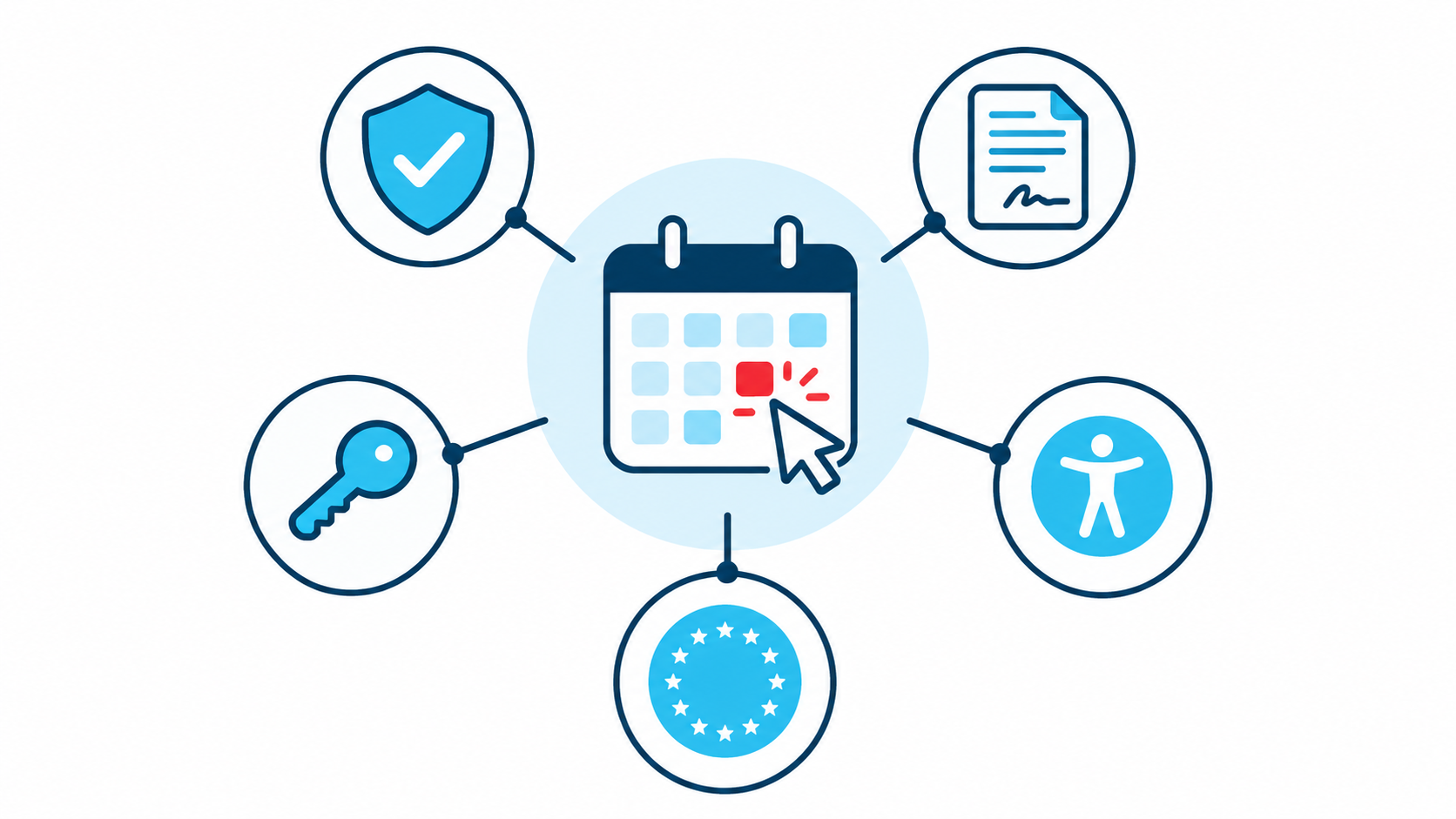
Five EU rule sets come up in almost every review, and which ones apply depends on who you are. DORA has applied since January 2025 and covers banks among other financial entities. The European Commission’s NIS2 overview lists public administration at central and regional level among the sectors in scope.
| Rule | Who it applies to | What it means for a scheduling platform |
| DORA (Regulation 2022/2554) | Banks and other financial entities, since 17 January 2025 | ICT third-party risk management, mandatory contract terms, an exit plan for the vendor |
| NIS2 (Directive 2022/2555) | Public administration and other essential sectors; for financial entities, DORA takes precedence | Cybersecurity risk-management measures, including supplier relationships |
| GDPR | Any organisation processing personal data | Data minimisation, retention limits, a data processing agreement |
| European Accessibility Act (Directive 2019/882) | Consumer banking services provided after 28 June 2025 | Accessible booking websites and apps |
| Web Accessibility Directive (2016/2102) | Websites and mobile apps of public sector bodies | Booking pages that meet the EN 301 549 standard |
What security features should a compliant scheduling platform have?
Certified security comes first, followed by identity controls and privacy-protective defaults. Each one gives your reviewers something concrete to check.
Certified information security
ISO/IEC 27001 is the international standard that sets the requirements for an information security management system. A certificate means an external auditor has examined how the vendor actually runs security, which tells you far more than a polished demo. Ask for the certificate, its scope and a summary of the latest penetration test. Scope matters: a certificate that covers the sales office but not hosting operations proves very little.
Linistry, a customer journey platform for appointment booking and queue management used by banks, retailers and public bodies, runs as an ISO 27001-certified, penetration-tested SaaS on Microsoft Azure.
Identity and access control
Staff accounts are a common weak spot. Look for single sign-on through your existing identity provider, such as Microsoft Entra ID, so a leaver loses access the day their account is closed. Permissions should separate a branch advisor from a branch manager and from a central administrator, and changes to services or opening hours should leave a trace. Linistry’s appointment booking system signs users in with SSO and connects to Entra ID.
Personal data protection by default
The European Commission’s guidance on data protection by design and by default asks for safeguards from the earliest design stage and the most protective settings out of the box: only the personal data you need, short storage periods, limited access. In booking terms, ask for the reason of a visit only when routing depends on it, delete appointment data on a fixed schedule, and hide personal details from staff who won’t serve that customer. Ask where data is stored and processed, too. DORA will need that answer.
What contract terms does DORA expect from a scheduling vendor?
DORA expects the contract to cover the whole relationship, from where your data sits to how you can walk away. The regulation’s preamble describes the elements your contract should include:
- the locations where the service is provided and data is processed
- service levels with precise performance targets
- access to your data, and its recovery and return if the vendor stops operating
- access, inspection and audit rights
- termination rights and an exit strategy with a transition period
Fewer vendors also means less oversight work. MBH Bank used to run queue systems from several vendors. It moved nearly 400 locations onto one Linistry platform for queue management and appointment scheduling, and customer waiting times fell by 30%. At a Top 30 European banking group member bank with 200 branches, a self-built booking tool broke down over the 2021 Christmas holidays. The move to Linistry had to clear the bank’s information security requirements, and afterwards the share of booked visits grew from 5% to 30%.
Why does accessibility belong to the compliance checklist?
Because for many banks it’s now a legal requirement, and public bodies have had a similar duty for years. The European Accessibility Act covers consumer banking services provided after 28 June 2025. Its accessibility principles ask that interfaces be perceivable, operable, understandable and robust.
For the public sector, the Web Accessibility Directive applies to the websites and mobile apps of public sector bodies, with EN 301 549 as the technical reference. In practice, your booking flow should work with a keyboard and a screen reader, use sufficient contrast and plain language, and offer the languages your customers speak. With a fully white-labelled booking page, every accessibility gap carries your brand, not the vendor’s. That’s a good reason to test it yourself.

The bottom line
In a regulated industry, compliance is something your organization proves, and a compliant scheduling platform is one that makes that proof easy. Look for an external certificate rather than a promise, identity controls that plug into your directory, privacy-protective defaults, contract terms that match DORA, and booking pages everyone can use.
Linistry supports this work for banks including MBH Bank, UniCredit and Banca Transilvania. If a security review is coming up, a free consultation is a good way to walk through the certificates and contract terms before the questionnaire lands on your desk.
Frequently asked questions
Is there such a thing as DORA-compliant scheduling software?
No. DORA applies to banks and other financial entities, not to the software they use. A scheduling vendor can support your DORA compliance by accepting the required contract terms, documenting its security controls and allowing audits and a clean exit. Treat any “DORA-certified” label with caution.
Why does ISO 27001 matter when choosing scheduling software?
ISO/IEC 27001 certification shows that an independent auditor has checked the vendor’s information security management system against an international standard. It gives your security team a shared reference point and shortens the review. Always check what the certificate’s scope covers.
Does the European Accessibility Act apply to bank appointment booking?
It can. The act covers consumer banking services provided after 28 June 2025, and an online booking channel is often part of how that service reaches customers. Check the scope with your legal team and expect customer-facing booking pages to meet the act’s accessibility requirements.