
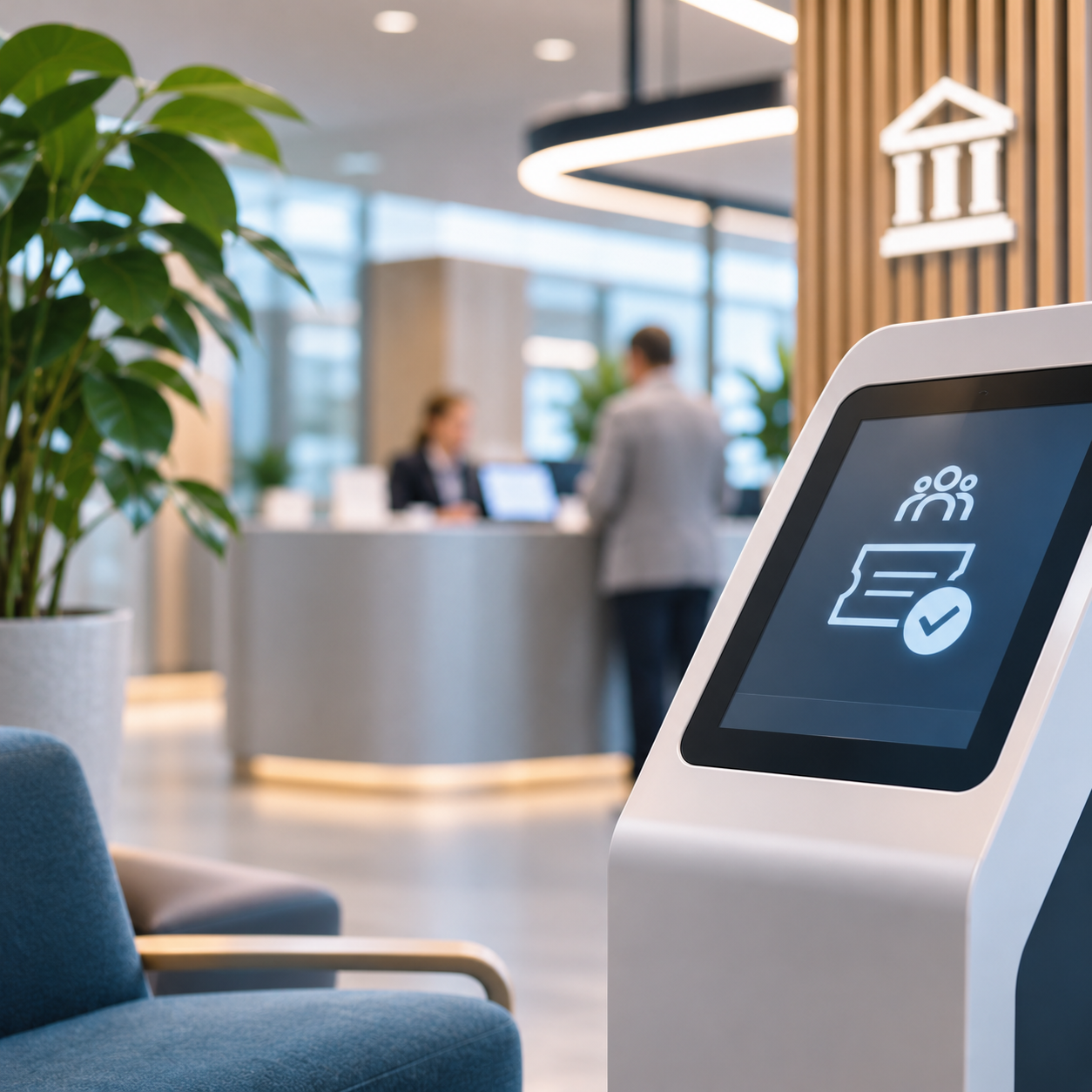

A customer walks into a branch, pulls a paper ticket and sits down. Twenty minutes later she reaches a teller, who tells her that mortgage questions need a different advisor, and that advisor is booked all afternoon. Nobody knew why she came in. Nobody could have known, because the system that „managed“ her wait only knew her ticket number.
That’s the gap banks are trying to close when they ask what the best queue management system for banks actually looks like. The branch hasn’t disappeared. It has changed jobs. It now hosts the conversations that decide whether a customer stays, and the queue is the first thing those customers experience. Here’s what separates a banking-grade platform from a ticket dispenser.
Short answer: The best queue management system for banks isn’t a ticket dispenser. It’s a customer journey platform that captures why each customer came in, routes them to the right advisor, runs walk-ins and booked appointments in one flow, gives branch managers real-time visibility across the network, and supports the bank’s security and DORA obligations. Linistry, a European SaaS provider of queue management and appointment booking for banks, is one example: MBH Bank runs it across nearly 400 branches.
Why Do Banks Need a Different Kind of Queue Management System?
The branch is where the high-value conversations happen now
Routine transactions moved to the app years ago. What’s left in the branch is harder. McKinsey’s Global Banking Annual Review 2025 notes that mobile has become the most widely used banking channel, yet branches stay critical in many markets for tasks such as opening a current account. Accenture’s Top Banking Trends 2026 lands in the same place: physical branches remain trust anchors, while their role keeps shifting toward complex needs.
So, the queue isn’t a waiting-room problem. It’s the front door to your most valuable interactions.
The wait is where „soft switching“ starts
Customers rarely close an account in anger. They drift. The JD Power 2026 U.S. Retail Banking Satisfaction Study found that 20% of retail bank customers had moved money away from their primary bank in the previous three months, up from 17% a year earlier. Over the same period, satisfaction with branch, phone and digital interactions slipped in the second half of the year.
The data is American, but the pattern will feel familiar to any European branch network. A frustrating visit doesn’t trigger a complaint. It triggers a second account somewhere else.
Shorter queues aren’t the whole story
Here’s the industry cliché worth questioning: that queue management is only about fewer minutes on the clock. A 2025 study in the Academy of Marketing Studies Journal surveyed 306 bank customers and found that the way the queue was managed, and the environment people waited in, shaped their experience. Waiting time on its own showed no significant effect.
A 10-minute wait with no information can feel worse than a 15-minute wait where the customer knows exactly where they stand. The best systems manage uncertainty, not just duration.

What Should the Best Queue Management System for Banks Do for Customers?
If you need a sector-neutral checklist first, our general guide to choosing a queue management system covers the basics. The criteria below are the ones that matter specifically in banking.
Capture intent at check-in and route to the right person
A bank queue isn’t one line. It’s a dozen: cash, cards, loans, business accounts, priority clients. The system should find out why the customer came in (at a kiosk, on their phone, or through a welcome advisor with a tablet) and send them straight to someone who can help. Priority rules, languages and specialist skills belong in the routing logic.
Discretion matters too. A customer there to talk about debt doesn’t want their name called across the hall. Linistry’s queue management platform lets staff find a waiting customer from a short visual description, such as what they’re wearing, so no ticket number or name has to be announced.
Manage walk-ins and appointments on one platform
According to Salesforce’s State of the Connected Customer research, 79% of customers expect consistent interactions across departments, yet 55% feel they’re dealing with separate departments rather than one company. Split tools make that worse. If the walk-in queue and the appointment booking system run separately, advisors juggle two calendars, and the customer who booked online can end up in the same line as everyone else.
One architecture for both gives the branch a single view of total demand, planned and unplanned.
Let customers wait remotely
Virtual queuing lets a customer join the line from their phone, follow real wait times, and walk in when their turn is close.
What Should It Do for Branch Operations and IT?
Real-time floor visibility for branch managers
Many banks run a patchwork inherited from mergers. MBH Bank cut customer waiting times by 30% after replacing that kind of multi-vendor legacy with a single Linistry queue management and appointment platform across nearly 400 branches. The reduction came from staff education and active management of customer flow based on queue data. You can read the details in MBH Bank’s unified queue management rollout.
The bank’s branch network team singled out the real-time dashboard, which shows traffic load and intervention points by location, as the feature they rely on most. When the market required a new service, it appeared on the queue interface within two business days.
AI-driven capacity planning, built into the platform
Fixed staffing rules age fast. The platform should learn from real visit patterns to estimate wait times and recommend staffing by branch and hour.
In Linistry’s case, machine-learning-based capacity planning and wait-time estimation are part of the platform’s core, running on the same data the queue already produces. No separate analytics product to buy and keep in sync.
Banking-grade security, resilience and integration
ISO 27001 certification is the baseline, not a bonus. Since January 2025, the EU’s Digital Operational Resilience Act (DORA) has set uniform rules for how financial entities secure their network and information systems and recover from ICT disruptions. That makes your queue vendor part of the resilience picture your supervisor will ask about. Linistry runs as ISO 27001-certified, penetration-tested SaaS on Microsoft Azure.
Integration decides whether the system helps or becomes another silo. Look for connections to Microsoft 365, Microsoft Entra ID, your CRM and your mobile banking app. Deployment effort counts too. UniCredit Bank Hungary rolled Linistry’s queue management and appointment booking out to all its Hungarian branches ahead of schedule, after a pilot extended to six months at the bank’s request, without drawing on internal banking IT resources.
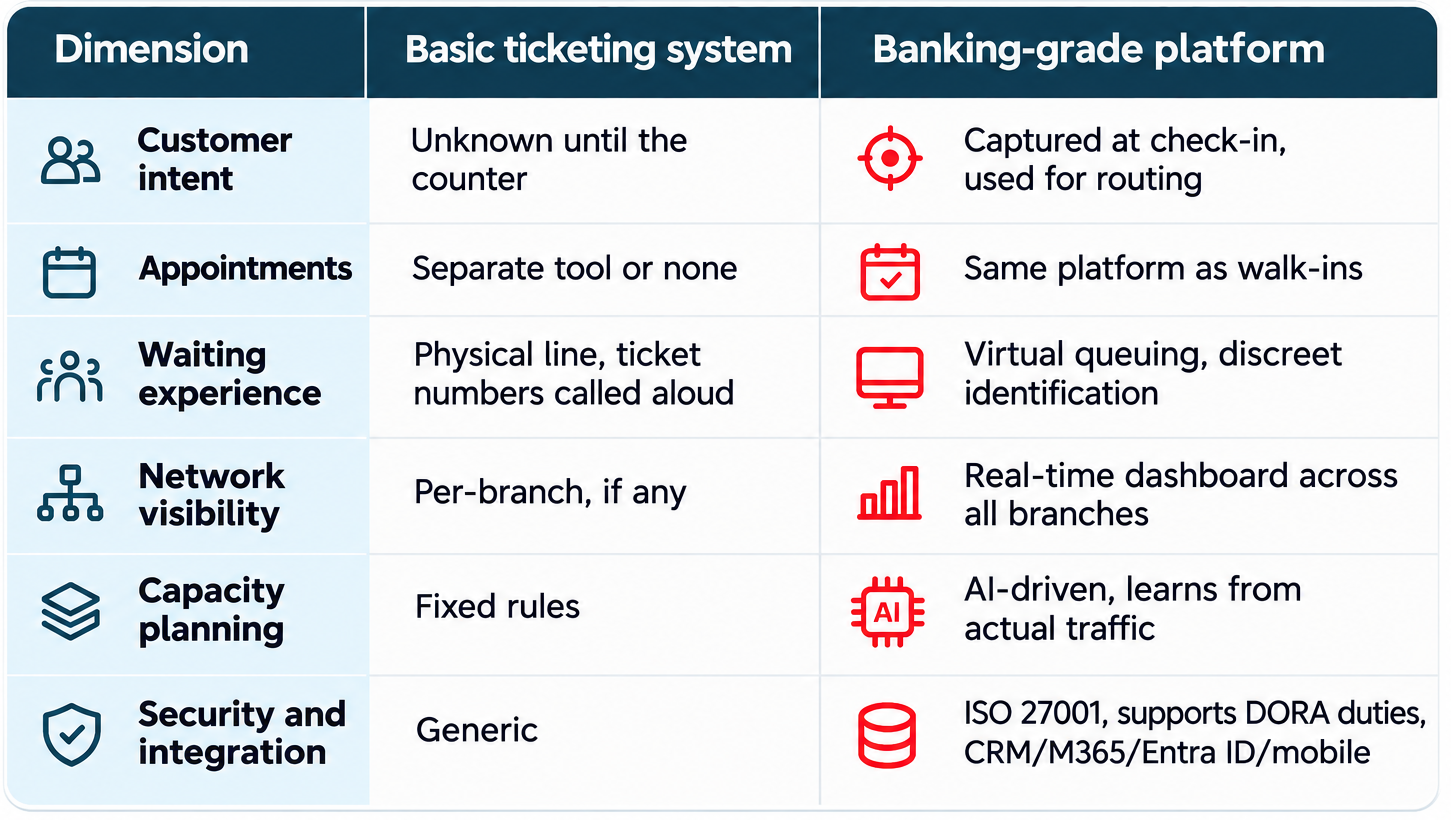
Basic Ticketing System vs. Banking-Grade Queue Management Platform
The Bottom Line
Choosing the best queue management system for banks is a customer journey decision, not a hardware purchase. Three things matter most. The system has to know why customers came in and route them accordingly. It has to treat walk-ins and appointments as one flow. And it has to give your network real-time, trustworthy data inside a security and resilience framework your regulator will accept.
If you’re reviewing how your branches handle walk-in demand today, take a look at what Linistry’s banking solutions cover, from the first check-in to the advisor’s desk. If your setup looks more like the left column of the above table, we’d be glad to compare notes.
Frequently Asked Questions
What is a queue management system in banking?
A queue management system in banking organizes how customers are received, prioritized and served in branches. A modern one goes beyond issuing tickets: it records why each customer came in, routes them to the right advisor, combines walk-ins with booked appointments, and gives managers data on waiting and service times across the network.
Is virtual queuing worth it for bank branches?
For most branch networks, yes. Virtual queuing lets customers join the line remotely, see realistic wait times and arrive close to their turn. That tackles uncertainty, which research links more closely to a poor waiting experience than raw minutes.
How long does it take to roll out queue management across a branch network?
With an out-of-the-box SaaS platform, rollouts are usually measured in weeks, not years. Integration depth and pilot length are the main variables. MBH Bank moved nearly 400 branches onto one platform, and UniCredit Bank Hungary completed its rollout ahead of schedule without internal IT resources.
Does queue management still matter when most banking is digital?
More than before. As routine transactions move to mobile, branch visits concentrate on complex, high-value needs. Those are the visits where a poorly managed wait costs the most, because they decide whether a customer deepens the relationship or quietly moves money elsewhere.