
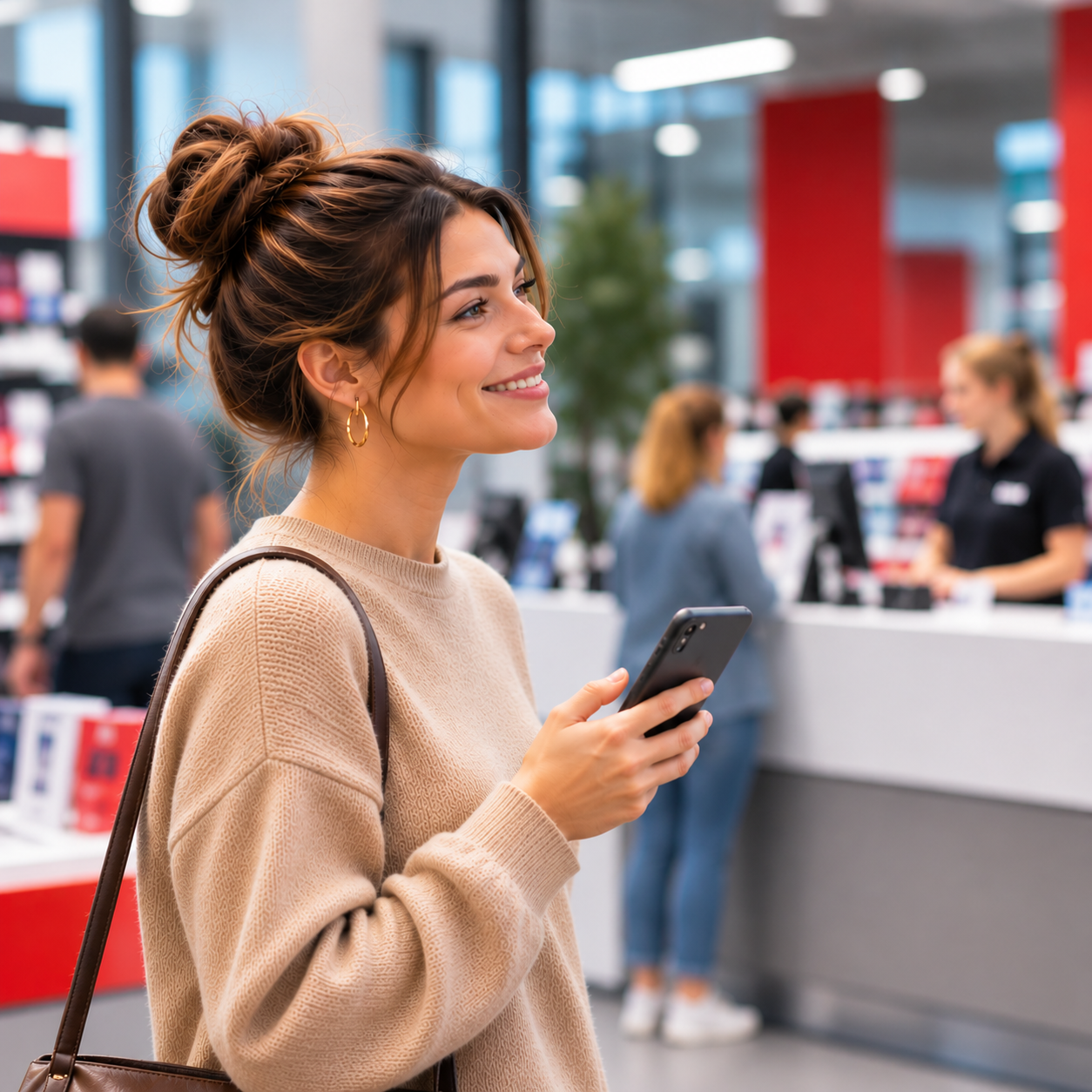

Self-checkout was supposed to kill the line. It didn’t. It just moved it. Ask a store manager where customers still wait, and the answer is rarely the cash register anymore. It’s the returns counter, the credit desk, the one associate who can explain technical features of a new appliance. Retailers automated the transaction and left the moments that need a human running on a clipboard and a hunch. That gap is what a modern retail queue management system is built to close.
Short answer: The best retail queue management system combines virtual queuing, a mobile app that connects waiting customers to available staff, and machine-learning-based capacity planning, all in one platform rather than bolted-together tools. It should let shoppers browse instead of standing in line, and give managers live visibility into wait times and staffing gaps before they turn into lost sales. MediaMarkt, for instance, used Linistry’s platform to save 3 million minutes of waiting time and reach a Net Promoter Score above 90%.
Why does queue management still matter when self-checkout is everywhere?
Because the conversations that still happen in the store are the ones that drive revenue. Nobody automates a financing question, or the sofa that has to fit a specific living room. Make that customer wait too long, and they leave.
A 2026 IBM–NRF study of more than 18,000 consumers in 23 countries found that a visually appealing store with no waiting was the most desired shopping experience, ahead of AI personal shoppers, super-apps and social commerce. Shoppers aren’t asking for more novelty. They’re asking not to stand around.

What does a long queue actually cost a retail chain?
More than the customers who walk out. It also costs you the people running the floor. Zebra’s Global Shopper Study found that 85% of retail decision-makers feel their operations managers spend too much time managing the workforce, and about eight in ten say store staff struggle to get timely support. A queue with no visibility is a queue nobody manages. Staff react to the line instead of preventing it.
Retailers are putting money behind the fix. Dataintelo’s queue management system market report projects the market to grow from $0.73 billion in 2025 to $1.87 billion by 2034, with retail already the largest end-user segment at roughly 22.4%.
What features separate a best-in-class retail queue management system from a basic one?
A basic system prints tickets faster. G2’s queue management category judges serious platforms on ease of use, clerk and location performance reports, and digital signage. For retail, add one more test: besides giving a customer a place in line, can the system connect them to a specific available associate? The best platforms handle both from the same app.
| Capability | Basic queue system | Best-in-class retail system |
| Waiting | On-site only, ticket number on a screen | Virtual queuing: customers browse the store or wait off-site while tracking their turn |
| Staffing | Fixed schedules, no visibility into demand | Machine-learning-based capacity planning using historical visit patterns |
| Reporting | End-of-day ticket counts | Real-time dashboards with alerts and staff activity tracking |
| Requesting help on the floor | No mechanism; customer has to find someone | Mobile app lets customers scan a QR code or use a store kiosk to call a specific associate |
| Staff coordination | Walking the floor to find a colleague | Mobile app lets staff message or call each other for backup, with escalations if no one responds |
| Deployment | Multi-year IT project, on-site servers | Cloud SaaS, live in weeks, no on-site infrastructure to run |
| Security and branding | Generic vendor interface | ISO 27001-certified, fully white-labelled in the retailer’s own brand |
| Integration | Standalone kiosk | Connects to CRM, Microsoft 365, Azure AD, and POS systems |
(For a cross-industry checklist that also covers banks and telecoms, see our general guide to choosing a queue management system.)
Capacity planning is where most retailers underinvest. Before adopting Linistry, JAF Holz, a building-materials supplier serving contractors and DIY retailers, had no record of when customers actually showed up. Once visit data started flowing into heatmaps, staffing stopped being a guess.
Should queue management stop at the line, or cover the whole floor?
Plenty of lost sales never form a line. A shopper who can’t find an associate doesn’t queue up. They leave, and no queue log ever records it.
Fixing that takes a mobile app. In Linistry’s Retail Orchestration, a customer scans a QR code or taps a store kiosk, and the request lands on an associate’s phone as a push alert. That’s the Sales Caller module. Its sibling, Staff Caller, lets employees call each other for backup from the same app, whether they’re at the cash desk, in the warehouse, or alone on the floor. Queue management, appointment booking and both caller modules run on one platform, so the store isn’t juggling separate tools.
Mömax, a furniture and home-decor retailer with 1,100 employees in Hungary, had no way for customers to signal they needed help. With Linistry Retail Orchestration, it now handles over 200 help requests a month, with faster responses and fewer walkouts. „The combination of a reliable system and a dedicated support team made Linistry a partner worth recommending,“ says Dániel Németh, Sales Manager at mömax.
How MediaMarkt turned 3 million minutes of waiting into shopping time
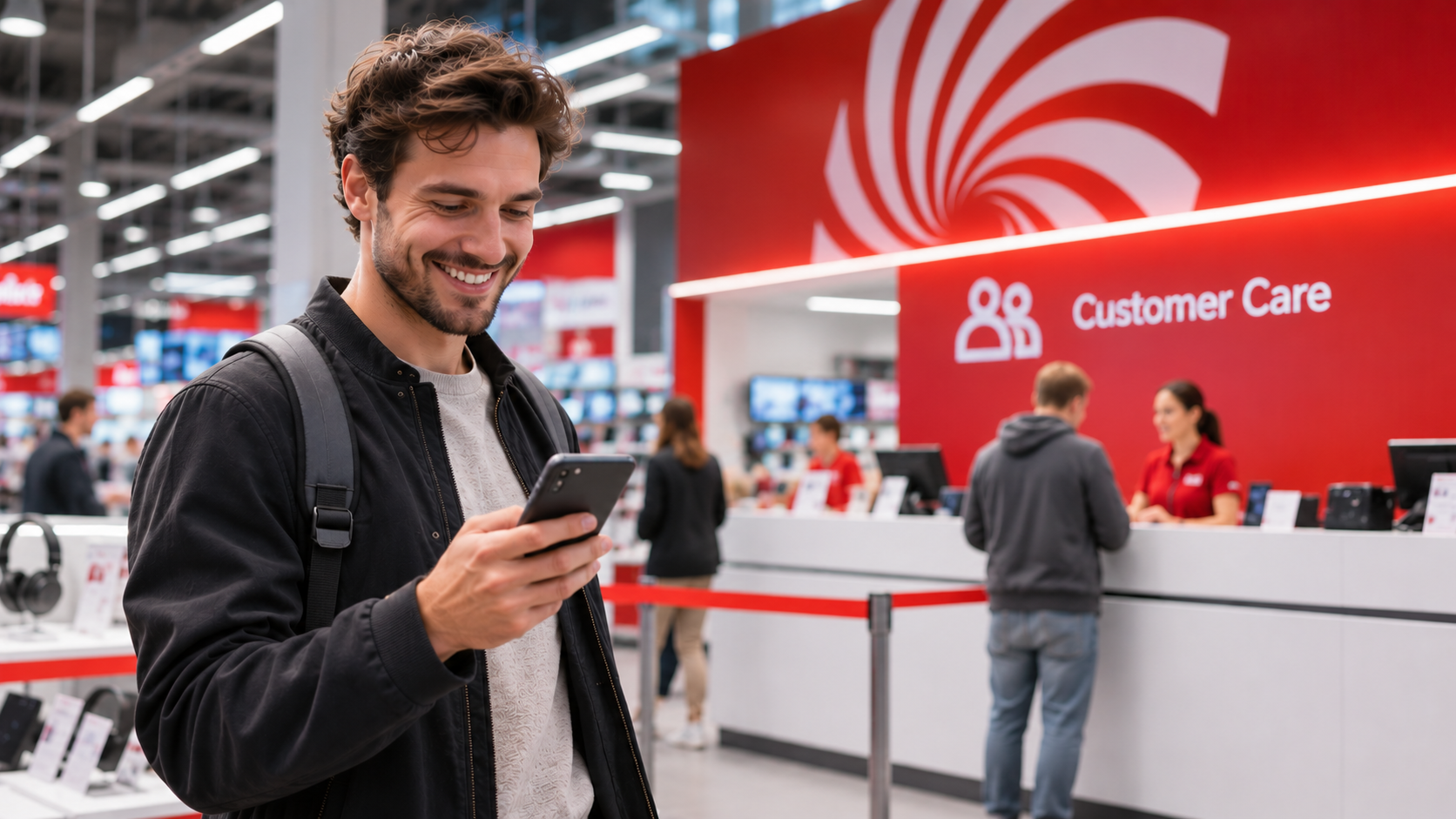
During promotions, waits at MediaMarkt Hungary’s credit and customer-care desks ran past 30 minutes, and staffing didn’t match the flow of customers. MediaMarkt rolled out Linistry’s queue management system in about two months. With virtual queuing, customers kept shopping instead of standing at the desk. The result: 3 million minutes of waiting saved, 1 million of them turned into shopping time in a single year, and a Net Promoter Score above 90%, on a low initial investment that paid back quickly. Regional Operations Manager Zoltán Szemethy called the decision „an easy and obvious choice.“ The full MediaMarkt case study has the details.
The bottom line
Self-checkout solved the easy part of retail waiting. The hard part, the moments that need a person, is still where customers walk out and staff burn out. The retailers fixing it pick a retail queue management system that queues customers, calls staff to the floor, plans capacity with machine learning and plugs into the tools they already run. AI sits inside how that platform plans and routes, not on top of it as a separate assistant. That’s how in-person service stops being a cost center.
Linistry is the customer journey platform behind that shift for retail chains including MediaMarkt, mömax and JAF Holz, as well as banks across Europe. If long waits or unanswered floor requests are costing your stores sales, a free consultation will show you what a connected setup looks like in your stores.
Frequently asked questions
What is a retail queue management system?
A retail queue management system is software that organizes how customers wait for service in a store, using virtual or on-site queuing, live wait-time displays and staff dashboards instead of a ticket dispenser and guesswork. In retail it usually covers service desks, credit counters, fitting rooms and click-and-collect points.
How much does a queue management system cost for a retail chain?
It depends on store count, the number of service points per store and the modules you need. Virtual queuing with reporting costs less than a package with staff calling and CRM integration. Most deployments run as a cloud subscription with no on-site infrastructure. For an accurate figure for your store network, a free consultation beats a generic price list.
How long does it take to implement a queue management system in retail stores?
Typically a few weeks to a couple of months, depending on integrations. Out-of-the-box cloud platforms are the fastest to deploy. MediaMarkt went from decision to live stores in about two months.
Does a retail queue management system support virtual or remote queuing?
Yes. Virtual queuing is now a standard capability. Customers reserve their place remotely or by scanning a QR code in the store, keep shopping, and get notified when it’s their turn, while staff follow the queue on a dashboard or their phone.