

McKinsey’s State of the Consumer 2026 report, based on a survey of 4,863 consumers in Brazil, France, Germany, the UK and the US, identifies two forces reshaping the sector – fast-moving technology and persistent cost pressure – which together drive four global consumer trends for 2026.
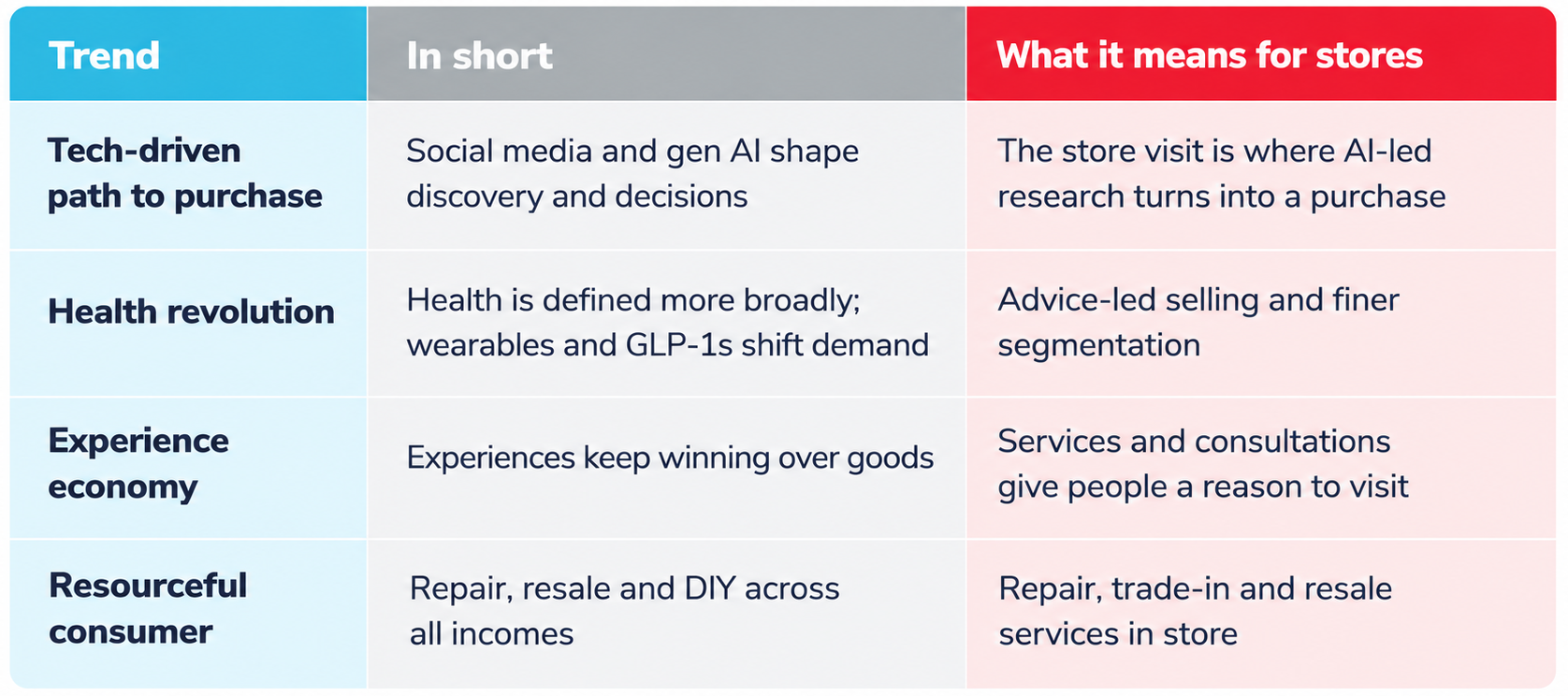
The four consumer trends of 2026 identified by McKinsey, and what each means for physical stores
1. The tech-driven path to purchase
Social media and generative AI are increasingly shaping how people discover and buy products, especially among Gen Z. According to McKinsey, 28% of Gen Zers already use gen AI tools for shopping (versus 16% of baby boomers), and 60% regularly use the AI overviews at the top of search results (versus 29%) – even though they report lower trust in both social media and gen AI than older shoppers do.
Traditional search is being reshaped by AI-generated answers, which reduces click-throughs to brand and retailer sites. In consumer goods, only about 1% of the sources cited by LLMs come from brand-owned websites, pushing companies toward „generative engine optimization“ (GEO), stronger earned media and third-party validation. Agentic commerce – AI agents completing purchases on consumers‘ behalf – is emerging as a „dual front door“ for shopping, with major platforms such as Shopify, Amazon and Walmart aligning on standards for AI-enabled transactions.
2. The health revolution
Consumers are defining health more broadly (sleep, stress, gut health, cognitive function), aided by wearables and health-tracking devices – yet fewer than half feel they’re meeting their wellness goals. GLP-1 (glucagon-like peptide) medications are spreading quickly and already affecting grocery spending patterns: US households that adopted them cut grocery spend by about 6% within six months. Growth diverges by region: the US is furthest ahead, Brazil could accelerate as patents expire and cheaper options arrive, while Europe remains more constrained at around 2% of the population. Companies are responding with more targeted products and finer consumer segmentation across the five wellness archetypes McKinsey identifies.
3. The experience economy
Even under budget pressure, consumers keep prioritizing experiences – travel especially – over goods. Between 2023 and 2025, the global experiences market grew 2.6%, while non-essential goods grew just 0.8%. Digital and at-home experiences (streaming, gaming) are becoming legitimate substitutes for in-person ones. Luxury travel is outgrowing the mainstream market, while cost still remains the top factor in experience purchases. Brands like Pop Mart and Trolli are cited as examples of building experience ecosystems and partnerships to deepen engagement.
4. The resourceful consumer
Sustained price pressure has pushed more than three-quarters of consumers toward trade-down behaviors – reuse, repair, secondhand buying and DIY. Some 82% say they use items longer before replacing them, and 69% repair products rather than discarding them. This is no longer limited to lower-income households: higher earners are adopting these habits by choice rather than necessity. Recommerce, resale platforms and digital product passports are becoming more mainstream, and discount retailers such as Aldi and Lidl are forcing incumbents to compete harder on value across price points.
What do these consumer trends mean for physical stores?
The report’s overall message: brand equity and scale alone no longer guarantee success. Retailers need to adapt to fragmented, AI-mediated discovery, more nuanced consumer value calculations and shifting spending priorities.
For store-based retailers, there’s an encouraging detail in the data: even among Gen Z, 28% say they discovered new brands in a physical store, more than the 23% who did so on social media. The store still matters – but its job is changing. If AI does more of the research, the visit is where the decision gets confirmed, so advice, services and staff availability become the real differentiators. Consultations, repairs, trade-ins and order pick-ups all bring people in, and all of them might involve waiting.
That’s where many stores lose the experience they invested in. MediaMarktSaturn tackled it with Linistry Retail Orchestration: customers queue digitally for services such as financing, TV calibration and pick-up, then keep shopping or have a coffee until it’s their turn.
Want to see what the store of the future looks like? Download our free e-book, The Retail Store of the Future.